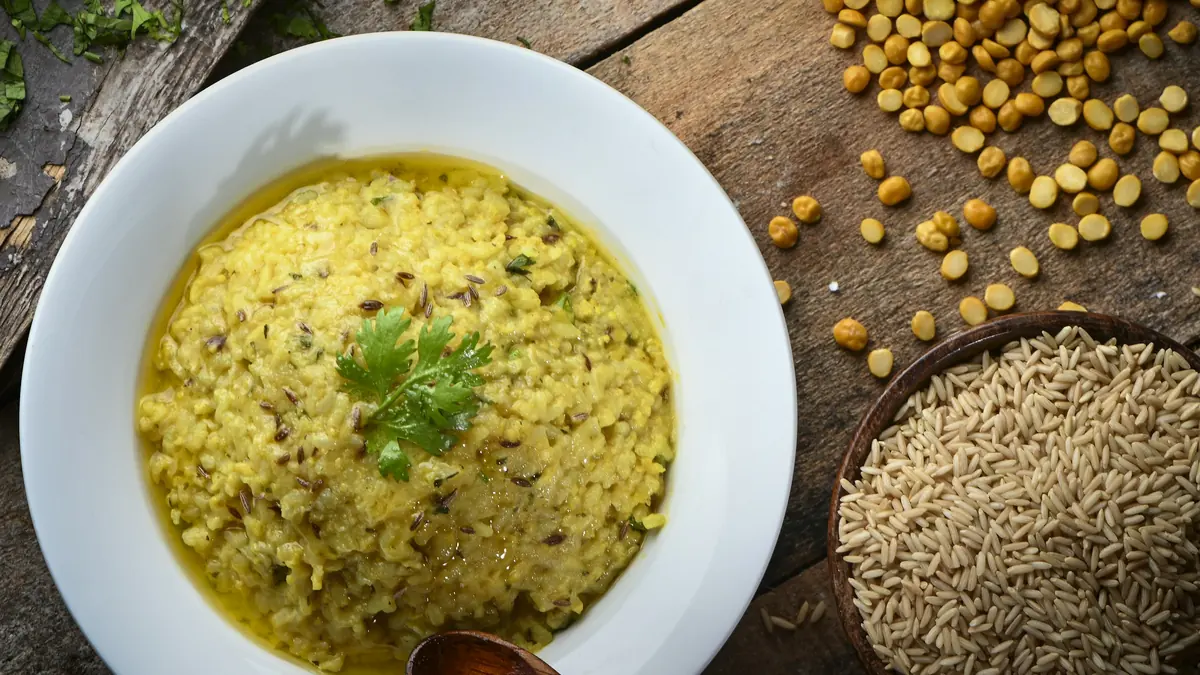
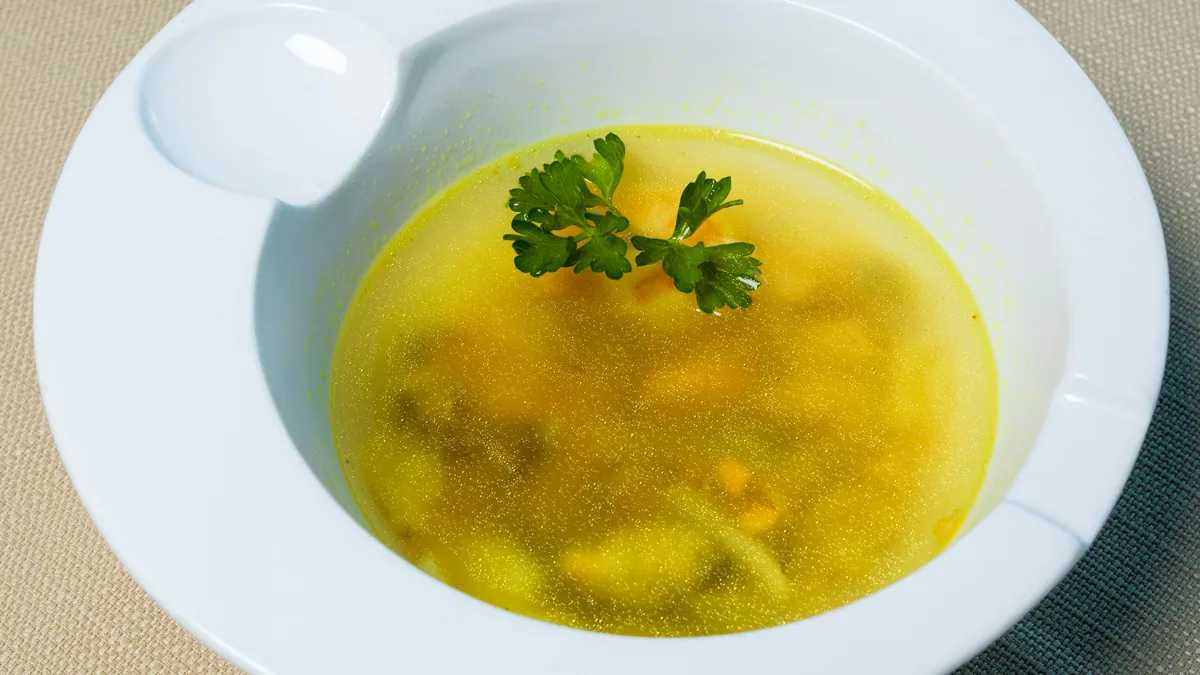
Yes, babies can have chicken yakhni from around 6 months, once they’ve started solid foods (AAP). Three changes make it baby-safe. Leave out the salt and stock cubes. Tie the whole spices in a small muslin pouch so you can lift them out. Strain the broth and pick the chicken off the bone by hand.
Yakhni is the slow-simmered chicken broth at the heart of Pakistani home cooking. It’s gently flavored with onion, garlic, ginger and whole spices, and it’s the base of yakhni pulao. In many desi homes it’s one of the first family foods a baby tastes. This baby version takes about 10 minutes to prep and 50–60 minutes to simmer, or about 20 minutes in a pressure cooker. It makes about 4 cups (1 liter) of broth plus 1½–2 cups of tender shredded chicken, enough for several meals.
Ages: 6 months+ · Serving ideas for 6, 7–9 and 9–12 months, plus toddlers
Baby-safe yakhni checklist
- No salt, stock cubes or gravy in your baby’s portion (NHS).
- Whole spices go in a muslin pouch and come out before serving, so no hard cardamom pods or seeds end up in the bowl.
- Strain twice and hand-check the meat. Bones in meat are a choking hazard (CDC).
- Cook chicken to 165°F (74°C) (USDA), and reheat leftovers to the same temperature. Then cool and test before serving (University of Illinois Extension).
- No chili for babies, and no honey or added sugar (CDC).
- Fridge for 1 day only, or freeze in portions (University of Illinois Extension).
Can babies have chicken yakhni?
Yes. Babies can have it from around 6 months, once they show the signs of being ready for solids: sitting up with support, good head control, opening their mouth for food, and swallowing rather than pushing food back out (AAP).
Chicken is a good early food. The NHS lists “meat without bones, such as chicken” among the finger foods babies can have from around 6 months. From 7–9 months, it suggests including iron-rich foods such as meat at meals (NHS). The AAP also recommends foods with iron and zinc, such as meat, from the start of solids (AAP).
One thing parents often miss is that the iron and zinc are in the chicken itself. The broth is lovely for flavor and for loosening purees, but serve the meat too, not just the liquid.
Baby yakhni vs family yakhni: what changes
The method stays almost the same. What changes is what goes into your baby’s bowl:
| Family yakhni | Baby yakhni | |
|---|---|---|
| Salt or stock cube | Yes | None |
| Whole spices | Loose in the pot | Tied in a muslin pouch (potli) and removed |
| Green chili / black pepper | Often | No chili; a few peppercorns inside the pouch at most |
| Bones | Simmered in, served | Broth strained twice; meat picked off by hand |
| Texture | Clear soup with pieces | Blended, mashed or shredded to suit the stage |
| Fat | Ghee or oil, often | A little is fine |
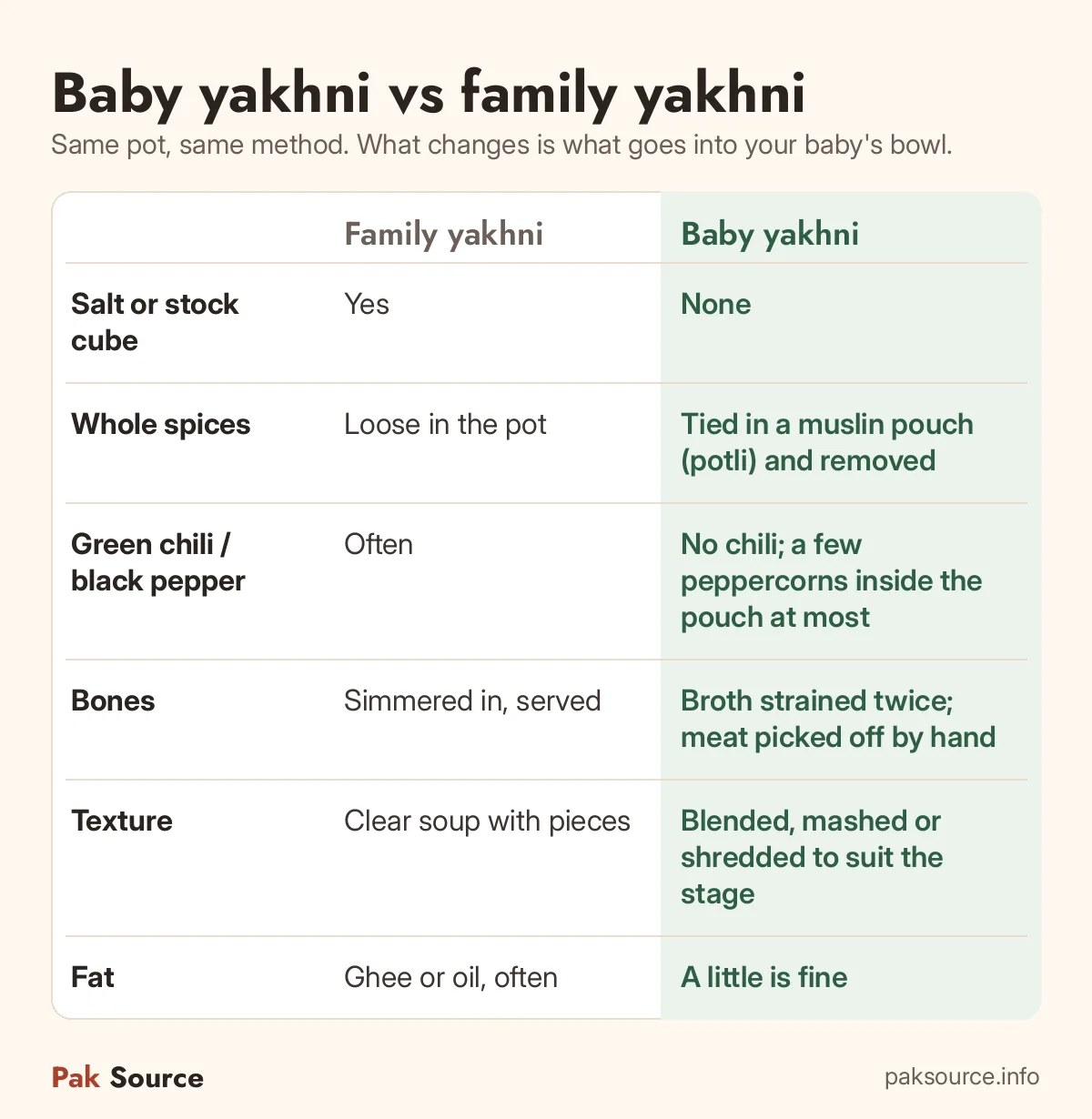
One pot for everyone: cook the yakhni as below. Ladle out your baby’s broth and chicken before you add salt, chili or garam masala, then season the rest for the family.
Chicken yakhni for baby: the recipe
Age: 6 months+ · Prep: 10 min · Cook: 50–60 min (stovetop) or about 20 min at pressure · Makes: about 4 cups (1 liter) broth + 1½–2 cups (250–300 g) shredded chicken · Cuisine: Pakistani · Allergens: none of the top 9
Ingredients
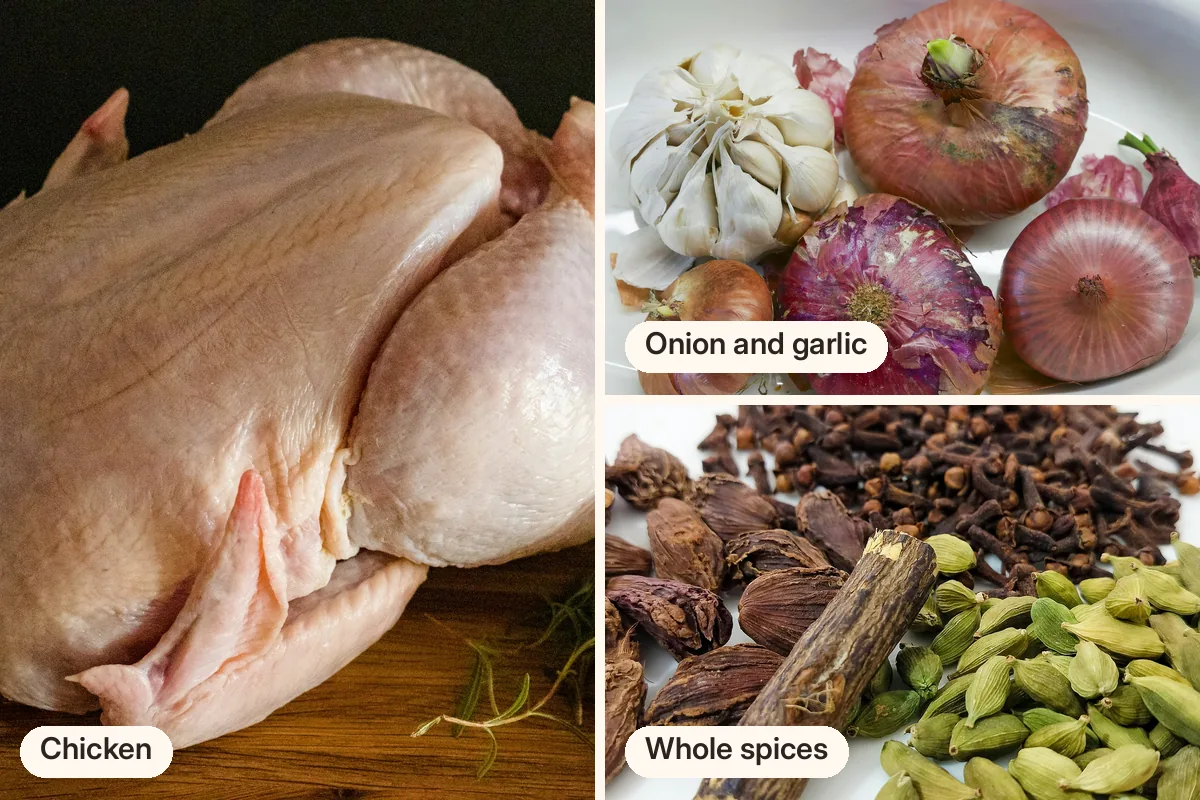
- 500 g (about 1.1 lb) bone-in chicken pieces, skin removed (thighs and drumsticks give the most flavor)
- 6 cups (1.5 liters) cold water for the stovetop method, or 5 cups (1.25 liters) for a pressure cooker
- 1 small onion, peeled and halved
- 3–4 garlic cloves, peeled and lightly crushed
- A 1-inch (2–3 cm) piece of fresh ginger, sliced
- Optional: 1 small carrot, cut into chunks, for extra sweetness
Mild spice pouch (potli), optional: 1 tsp coriander seeds, ½ tsp fennel seeds (saunf), ½ tsp cumin seeds, 2 green cardamom pods, 1 small cinnamon stick and 1 bay leaf. Tie them tightly in a square of clean muslin or a reusable spice bag.
Boneless chicken works too, but it gives a lighter broth. Don’t use stock cubes or shop-bought stock, which are usually salted.
Stovetop method
- Cover with water. Put the chicken straight into a large pot (don’t rinse raw chicken, which can spread bacteria around your sink) and cover it with the cold water.
- Boil and skim. Bring to a boil over medium-high heat. Skim off the grey foam that rises for the first 5 minutes, which keeps the broth clear.
- Add the aromatics. Add the onion, garlic, ginger, carrot (if using) and the spice pouch.
- Simmer gently. Turn the heat down so the broth barely bubbles. Partly cover and simmer for 50–60 minutes, until the chicken is falling off the bone.
- Check it’s cooked. The thickest piece of chicken should reach 165°F (74°C) on a food thermometer (USDA), with no pink meat or juices.
Pressure cooker or Instant Pot method
- Bring the chicken and water to a boil in the open pot (Sauté mode on an Instant Pot) and skim the foam.
- Add the aromatics and spice pouch, then lock the lid.
- Instant Pot: Pressure Cook on High for 20 minutes, then let the pressure release naturally for at least 15 minutes. Stovetop pressure cooker: bring to full pressure, lower the heat and cook for 15–20 minutes, then let it release naturally.
- Check the chicken reaches 165°F (74°C) before you go on.
Strain and pick the chicken
- Lift out and discard the spice pouch, onion and ginger slices.
- Lift the chicken onto a plate to cool.
- Pour the broth through a fine sieve. Strain it a second time, or line the sieve with muslin, to catch any small bone fragments.
- When the chicken is cool enough to handle, pull the meat off with your fingers. Feel each piece for small bones, cartilage and tough bits, and discard them along with the skin.
- Skim off some of the fat if you like. A little fat is fine for babies.
Season for the family afterwards: once your baby’s portion is set aside, return the rest of the broth to the pot with salt, black pepper and a green chili to taste.
How to serve yakhni at each stage
The NHS advises moving babies from smooth purees to mashed, lumpy and finger foods as soon as they can manage them (NHS). Here’s how yakhni fits in at each stage. Serve it warm, not hot.
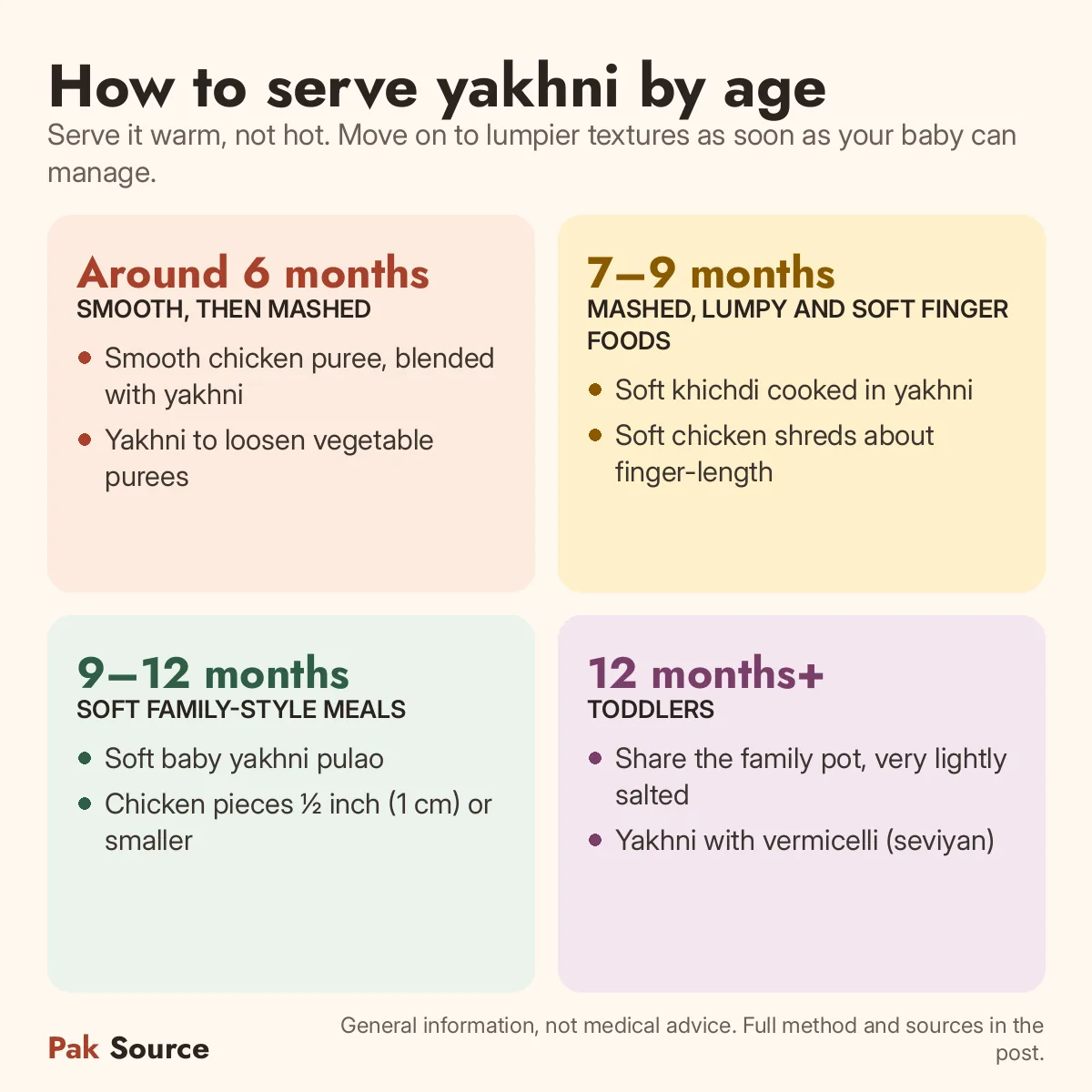
Around 6 months: smooth, then mashed
- Chicken puree: blend 2 tablespoons of shredded chicken with 3–4 tablespoons of yakhni until completely smooth. Add more broth for a thinner texture.
- Loosen vegetable purees: use yakhni instead of water to thin mashed sweet potato, carrot, pumpkin or peas.
- Cook grains in it: soft-cook semolina (suji), oats or split moong dal in yakhni and mash. Rotate grains rather than using rice every day (AAP).
7–9 months: mashed, lumpy and soft finger foods
- Soft khichdi: cook rice and moong dal in yakhni until very soft, then mash with a fork.
- Chicken and veg mash: stir finely shredded chicken into mashed potato or carrot, loosened with a spoonful of broth.
- Finger food: offer soft, moist shreds of chicken about the length of your finger for your baby to hold. Avoid chunks of meat, which are a choking hazard (AAP).
9–12 months: soft family-style meals
- Baby yakhni pulao: rinse rice and cook it in yakhni with extra liquid until very soft. Mix in small, soft pieces of chicken, cut to ½ inch (1 cm) or smaller (AAP).
- Thick chicken soup: simmer yakhni with diced soft vegetables and a little mashed potato until thick enough to stay on a spoon.
12 months+ and toddlers
- Share the family pot: take your toddler’s portion before salting, or salt the family pot very lightly. Toddlers aged 1–3 should have no more than 2 g of salt a day in total, across all their food (NHS).
- Yakhni with vermicelli: simmer a handful of broken vermicelli (seviyan) or small pasta in yakhni with shredded chicken. It makes a quick, comforting toddler meal.
For more ideas at this age, see what to feed a 1-year-old and our meal ideas for toddlers.
Can my baby drink yakhni from a cup?
A few sips of cooled yakhni from an open cup with a meal are fine. But in the first year, breast milk or formula should stay your baby’s main drink, with sips of water from a cup at mealtimes from around 6 months (NHS). Avoid filling your baby up on broth before they’ve eaten their solids.
How to store, freeze and reheat yakhni
- Cool quickly. Get the broth and chicken into the fridge or freezer within 1–2 hours of cooking (NHS).
- Fridge: 1 day. Cooked chicken for babies keeps for 1 day in a covered container (University of Illinois Extension).
- Freezer: best within 1 month. Freeze broth in ice-cube trays, and the shredded chicken (or chicken puree) in small portions. Pop them out into a freezer bag, then label and date it. Frozen portions stay safe longer, but taste best within a month (University of Illinois Extension).
- Defrost in the fridge overnight or on the microwave’s defrost setting, not on the counter, and use within 24 hours (NHS).
- Reheat once, to 165°F (74°C) or until steaming hot all the way through. Stir well, let it cool, then test it with a clean spoon before feeding (University of Illinois Extension; NHS).
- Throw away anything left in the bowl your baby ate from.
Variations
- Mutton or lamb yakhni: follow the same rules (no salt, spices in a pouch, strain well). Simmer longer, about 1½–2 hours on the stovetop or 35–40 minutes at pressure, until the meat is very tender. Shred it finely and check carefully for bone fragments.
- Vegetable yakhni: simmer onion, carrot, a little potato, garlic, ginger and the spice pouch in water for 30 minutes, then strain. It’s useful for loosening purees on vegetarian days.
- Yakhni with moong dal: cook split yellow moong dal in strained yakhni until it collapses, then mash. It’s a gentle first dal with extra flavor.
Chicken yakhni for baby: FAQs
Is yakhni good for babies?
It’s a simple, homemade way to add flavor to your baby’s food. The chicken provides protein, plus the iron and zinc that babies need from solid foods (AAP). The broth on its own is mainly for flavor and texture, so serve the meat too.
Can I give yakhni to my 6-month-old baby?
Yes, once your baby has started solids and shows the readiness signs. Start with a smooth chicken puree or a vegetable puree loosened with yakhni. If chicken is a new food, the AAP suggests introducing one new single-ingredient food at a time and waiting 3–5 days before the next new one (AAP).
Can I add salt to yakhni for my 1-year-old?
Under 1 year, don’t add any salt. Babies should have less than 1 g of salt a day. From 1 to 3 years the limit is no more than 2 g a day, and that’s across all food, including salt already in bread, cheese and other everyday foods (NHS). For a toddler, a very light pinch in the family pot is the most you’d want.
Can I use a stock cube or shop-bought stock?
Not for babies. The NHS says not to add salt, stock cubes or gravy to your baby’s food or cooking water (NHS). Homemade yakhni lets you control exactly what goes in.
Is chicken soup good for a baby with a cough or cold?
Warm, familiar food can be comforting when your baby is under the weather, but yakhni isn’t a treatment for a cough or cold. Get medical advice if your baby seems unwell. In the UK, the NHS says to call 111 if a baby under 3 months has a temperature of 38°C or higher, or a baby aged 3–6 months has 39°C or higher. Call 999 if your baby has difficulty breathing or is drowsy and hard to wake (NHS). In the US, call your pediatrician or 911.
How long does yakhni last in the fridge?
For babies, keep it for 1 day in a covered container in the fridge. Freeze anything you won’t use by then (University of Illinois Extension).
What’s the difference between yakhni and bone broth?
The difference is mostly in how they’re cooked. Bone broth is usually simmered from bones for many hours. Yakhni is a shorter simmer of meat on the bone with aromatics and whole spices, cooked mainly for flavor and as a base for pulao and soups. For babies, the same rules apply to both: no salt, strain well and store carefully.
More baby food ideas
- More homemade baby food recipes, including a red lentil dal and a chicken and vegetable mash
- What to feed a 1-year-old
- Meal ideas for toddlers
This article is for general information only and isn’t medical advice. Every child is different. Talk to your pediatrician (or GP or health visitor in the UK) about your child’s needs, especially if your child has a food allergy, eczema, a medical condition, or trouble with feeding or growth. If your child is choking or has signs of a severe allergic reaction (swelling of the lips or face, trouble breathing, becoming floppy or pale), call 911 in the US, 999 in the UK, or your local emergency number.
Sources
- American Academy of Pediatrics, HealthyChildren.org. When Can Babies Start Solid Foods? Updated 23 Jun 2026.
- AAP, HealthyChildren.org. Choking Prevention. Updated 27 Feb 2026.
- AAP, HealthyChildren.org. Heavy Metals in Baby Food: Reducing Risk of Exposure. Updated 26 Sep 2025.
- NHS. Your baby’s first solid foods. Reviewed 19 Feb 2026.
- NHS. Salt: the facts. Reviewed 17 Apr 2023.
- NHS Best Start in Life. Storing and reheating food. Accessed 2 Nov 2026.
- NHS. High temperature (fever) in children. Reviewed 3 Jan 2024.
- CDC. Choking Hazards. Page dated 11 Mar 2026.
- CDC. Foods and Drinks to Avoid or Limit. Page dated 14 Apr 2026.
- USDA Food Safety and Inspection Service. Safe Minimum Internal Temperature Chart.
- University of Illinois Extension. Feeding My Baby: Storing and Reheating. Accessed 2 Nov 2026.