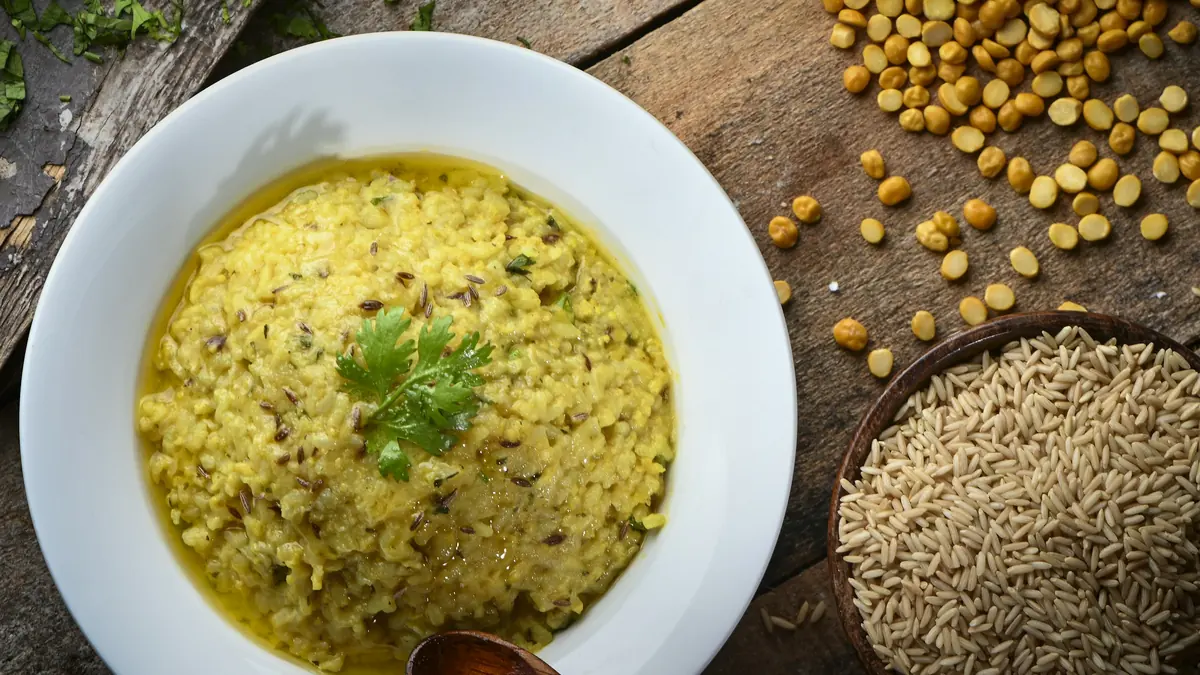
Yes, babies can have khichdi from around 6 months. Start with a smooth, runny khichdi once your baby has started solids and has already tried rice and moong dal on their own (AAP). Then make it thicker and lumpier as they grow. Don’t add salt, because babies shouldn’t have salt or stock cubes in their food (NHS). A little ghee, cumin and turmeric give khichdi plenty of flavor without it.
Khichdi (or khichri, as many Pakistani families spell it) is rice and split yellow moong dal cooked together until soft. It’s one of the most familiar first foods in South Asian homes. The only thing that really changes with your baby’s age is the amount of water and the texture. Below you’ll find a stage-by-stage water guide, pressure-cooker and stovetop methods, a chicken khichdi, travel tips, and what the FDA says about rice and arsenic.
Ages: 6 months+ · Textures for about 6, 7–9 and 10–12 months and toddlers
Baby khichdi checklist
- No salt, stock cubes or chili in your baby’s portion. Take it out before adding the family tadka (NHS).
- Match the texture to the stage: smooth, then mashed, then soft and grainy (NHS).
- Introduce rice and moong dal separately first, one new food every 3–5 days (AAP).
- Cooked rice keeps for 24 hours. Cool it quickly, refrigerate it, and use it within a day (Food Standards Scotland).
- Vary your grains. Rotate khichdi with oats, daliya and other grains rather than serving rice every day (FDA).
Can babies have khichdi, and from what age?
Recipe sites disagree on whether khichdi is for 6 or 8 months. Your baby’s readiness and the texture matter more than the exact age. Most babies are ready for solids around 6 months, once they can sit with support, hold their head steady, open their mouth for food and swallow rather than push it out (AAP). At that point, a smooth, thin khichdi is fine.
The NHS encourages moving babies from purees to mashed, lumpy and finger foods as soon as they can manage them (NHS). Khichdi suits that progression well, because you only need to change the water and how much you mash it.
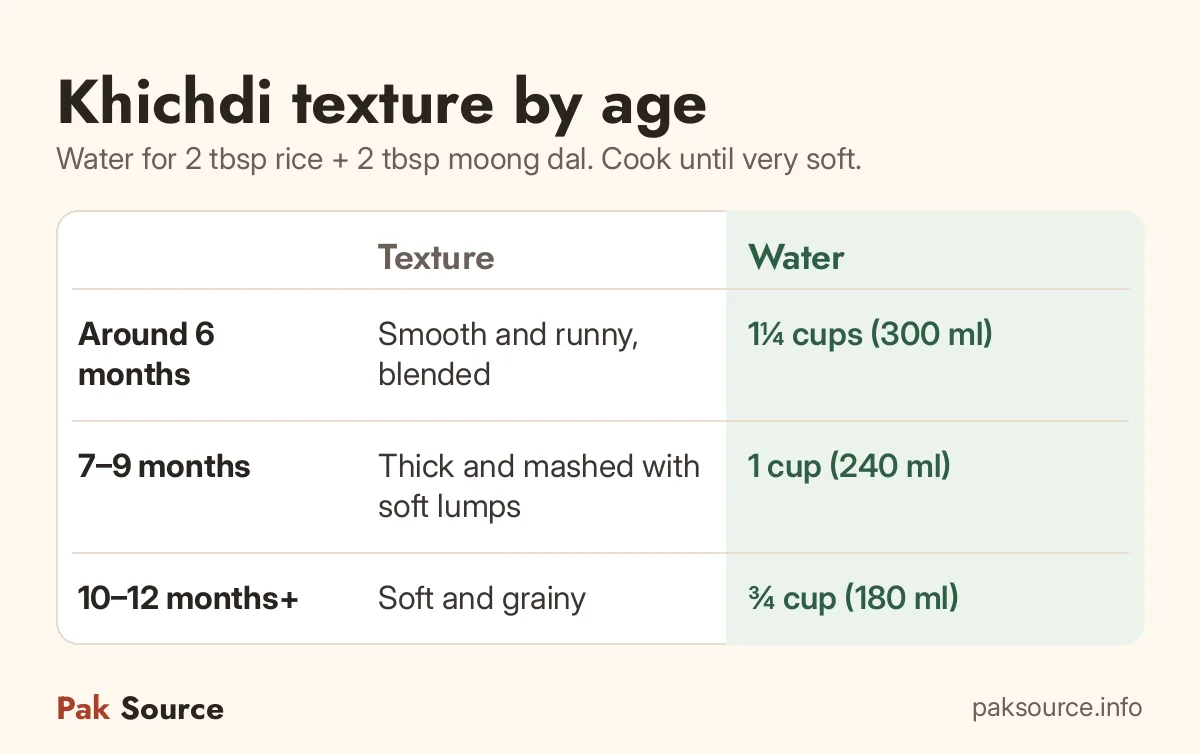
Khichdi textures by age
All three use the same base of 2 tablespoons rice and 2 tablespoons split yellow moong dal. Treat the water amounts as starting points. Every pot and rice variety behaves a little differently, so add a splash more hot water if it thickens too much.
| Age (approx.) | Texture | Water for 2 tbsp rice + 2 tbsp moong dal |
|---|---|---|
| Around 6 months | Smooth and runny; blended | 1¼ cups (300 ml) |
| 7–9 months | Thick and mashed, with soft lumps | 1 cup (240 ml) |
| 10–12 months+ | Soft and grainy, like the family’s | ¾ cup (180 ml) |
Moong dal khichdi for babies: the recipe
Age: 6 months+ · Prep: 5 min + 20–30 min soaking · Cook: about 15 min (pressure cooker) or 30–40 min (stovetop) · Makes: about 1 cup (3–4 baby portions) · Cuisine: Pakistani / Indian · Allergens: milk (in ghee). Use oil for a dairy-free version.
Ingredients
- 2 tablespoons white rice
- 2 tablespoons split yellow moong dal (dhuli moong)
- Water: see the table above (¾–1¼ cups / 180–300 ml)
- ½ teaspoon ghee, or a neutral oil
- A pinch of ground cumin (or ¼ teaspoon cumin seeds for babies 8 months+)
- A tiny pinch of turmeric (haldi)
- Optional: 2–3 tablespoons chopped carrot, pumpkin (kaddu) or bottle gourd (lauki)
Prepare
- Pick over the dal for stones. Rinse the rice and dal together until the water runs mostly clear. This removes dust and loose starch. If your rice is labelled “enriched”, skip rinsing it, because that washes off the added nutrients. Rinsing also makes little difference to arsenic (FDA).
- Soak them in fresh water for 20–30 minutes, then drain. Soaking helps both cook evenly and soft.
Pressure cooker method
- Warm the ghee in a small pressure cooker over low heat. Add the cumin and turmeric and stir for a few seconds. Don’t let the spices darken.
- Add the drained rice and dal, any vegetables, and the water for your baby’s stage.
- Stovetop pressure cooker: cook on medium heat for 3 whistles, then turn off the heat and let the pressure release naturally. Instant Pot: Pressure Cook on High for 12 minutes, then natural release for 10 minutes.
- Open, stir well, and check that the rice and dal are completely soft and falling apart.
Stovetop method (no pressure cooker)
- Warm the ghee with the cumin and turmeric in a heavy-based pan, then add the soaked rice, dal, vegetables and water.
- Bring to a boil, then lower the heat, cover with the lid slightly open, and simmer for 30–40 minutes. Stir every 5–10 minutes so it doesn’t stick, and add a splash of hot water if it gets too thick before the grains are soft.
- It’s done when the rice and dal have broken down and look creamy.
Finish to your baby’s stage
- Around 6 months: blend until completely smooth, adding hot water, breast milk or formula to make it runny.
- 7–9 months: mash well with the back of a spoon or a potato masher, leaving soft lumps.
- 10–12 months+: stir and serve as it is, soft and grainy. Older babies can pick up soft spoonfuls themselves.
Serve it warm, not hot. Stir well and test a little on a clean spoon first.
Cooking for the family too? Make a larger pot with salt-free water. Take out your baby’s portion, then add salt and a tadka of ghee, garlic, cumin and red chili to the rest.
Chicken khichdi for babies
Chicken adds iron and zinc, which babies need from their first foods (AAP). It also makes khichdi a more filling meal. There are two easy ways to add it:
- Cook it in yakhni: use salt-free chicken broth instead of water, then stir in finely shredded chicken at the end. See our chicken yakhni for babies.
- Cook the chicken in the pot: add 30–40 g (about 1 oz) of small, boneless chicken pieces with the rice and dal, and pressure-cook as above. Check that the chicken has reached 165°F (74°C) (USDA), then shred it finely or blend it into the khichdi for your baby’s stage.
Put raw chicken straight into the pot. Don’t rinse it, because that can spread bacteria around your sink.
Vegetable khichdi variations
Once your baby is happy with plain khichdi, add one new vegetable at a time:
- Carrot or pumpkin (kaddu): naturally sweet, and blends smoothly.
- Bottle gourd (lauki): mild and soft. Peel it and remove the seeds.
- Spinach (palak): add a small handful of chopped leaves near the end of cooking.
- Peas: blend them in for young babies, and squash them for older ones.
A note on rice and arsenic
Rice tends to absorb more arsenic from groundwater than other crops (AAP). That doesn’t mean you need to avoid rice. Khichdi can stay on the menu. The FDA and AAP advice is about variety (FDA):
- Rotate grains. Rice doesn’t need to be your baby’s first or only grain. Oats, barley, multigrain cereals, daliya (cracked wheat) and suji are all good options.
- Cooking rice in extra water, like pasta, and draining it reduces inorganic arsenic by 40–60%, depending on the rice. The FDA notes it also cuts some added nutrients (folate, iron, niacin, thiamine) in enriched rice. If you want to, boil the rice separately in plenty of water, drain it, then add it to the dal.
- Rinsing has only a minimal effect on arsenic.
- Avoid rice milk as a substitute for cow’s milk, and avoid snacks sweetened with brown rice syrup (AAP).
In practice, khichdi a few times a week alongside other grains is a balanced approach.
Khichdi for travel and busy days
- Homemade dry mix: dry-roast equal amounts of rice and moong dal on low heat until fragrant, cool, and grind to a fine powder. Store it airtight. To serve, simmer 2 tablespoons of powder with about ¾ cup (180 ml) of water for 8–10 minutes, stirring, until thick and smooth. Cook it fresh each time.
- Hot in a food jar: fill an insulated jar with boiling water for a few minutes, empty it, and add steaming-hot khichdi. Keep the lid closed until mealtime (USDA).
- Cold with ice packs: otherwise, carry it chilled in an insulated bag with two ice packs. Don’t keep cooked khichdi unrefrigerated for hours. Like any cooked rice, it should be cooled quickly and kept cold (Food Standards Scotland).
Storing, freezing and reheating khichdi
- Fridge: 24 hours. Cool cooked khichdi quickly, ideally within an hour, refrigerate it, and eat it within 24 hours (Food Standards Scotland).
- Freezer: freeze baby portions in lidded trays as soon as they’ve cooled. It’s best within 1 month (University of Illinois Extension).
- Thaw in the fridge overnight and use within 24 hours (NHS).
- Reheat once only, until steaming hot all the way through. Add a splash of water, stir well, let it cool, and test before serving (Food Standards Scotland; University of Illinois Extension).
- Throw away anything left in your baby’s bowl.
Khichdi for baby: FAQs
Can I give khichdi to my 6-month-old?
Yes, once your baby has started solids and has tried rice and moong dal separately. Make it smooth and runny, with no salt, and offer a few spoonfuls at first.
Can I add salt to my baby’s khichdi?
Not before 12 months. The NHS says not to add salt (including stock cubes) to babies’ food (NHS). From 1 to 3 years, children should have no more than 2 g of salt a day in total (NHS). A very light pinch in the family pot is the most you’d want.
Which dal is best for baby khichdi?
Split yellow moong dal (dhuli moong) is the classic choice because it’s small, needs no long soaking, and cooks down soft and creamy. Red masoor dal works too. Introduce each new dal on its own first. Beans, lentils and peas are on the NHS list of foods that can occasionally trigger allergies (NHS).
Can I make khichdi without a pressure cooker?
Yes. Soak the rice and dal for 20–30 minutes, then simmer them covered in a heavy pan for 30–40 minutes, stirring often and adding hot water as needed. See the stovetop method above.
Does khichdi cause constipation in babies?
Starting solids can change a baby’s poos, whatever the food. Offer sips of water with meals from around 6 months (NHS), and include fruit and vegetables alongside grains. If you think your baby is constipated, talk to your GP or pediatrician (NHS).
Can I give my baby khichdi every day?
It’s better to rotate. A varied diet is good for nutrition and limits repeated exposure to any one contaminant, including arsenic in rice (FDA). Alternate khichdi with oats, daliya, suji, potato and roti-based meals through the week.
More desi baby food
- Salt-free chicken yakhni for babies
- No-sugar gajar halwa for babies and toddlers
- Easy homemade baby food recipes
- What to feed a 1-year-old
This article is for general information only and isn’t medical advice. Every child is different. Talk to your pediatrician (or GP or health visitor in the UK) about your child’s needs, especially if your child has a food allergy, eczema, a medical condition, or trouble with feeding or growth. If your child is choking or has signs of a severe allergic reaction (swelling of the lips or face, trouble breathing, becoming floppy or pale), call 911 in the US, 999 in the UK, or your local emergency number.
Sources
- American Academy of Pediatrics, HealthyChildren.org. When Can Babies Start Solid Foods? Updated 23 Jun 2026.
- AAP, HealthyChildren.org. Heavy Metals in Baby Food: Reducing Risk of Exposure. Updated 26 Sep 2025.
- AAP, HealthyChildren.org. 5 Ways to Reduce Arsenic in Your Child’s Diet. Updated 15 Jun 2023.
- U.S. Food and Drug Administration. What You Can Do to Limit Exposure to Arsenic. Content current as of 27 Apr 2022.
- NHS. Your baby’s first solid foods. Reviewed 19 Feb 2026.
- NHS. Food allergies in babies and young children. Reviewed 22 Oct 2024.
- NHS. Salt: the facts. Reviewed 17 Apr 2023.
- NHS. Constipation in children. Accessed 2 Nov 2026.
- NHS Best Start in Life. Storing and reheating food. Accessed 2 Nov 2026.
- Food Standards Scotland. Rice. Accessed 2 Nov 2026.
- University of Illinois Extension. Feeding My Baby: Storing and Reheating. Accessed 2 Nov 2026.
- USDA Food Safety and Inspection Service. Safe Minimum Internal Temperature Chart and Keeping “Bag” Lunches Safe.