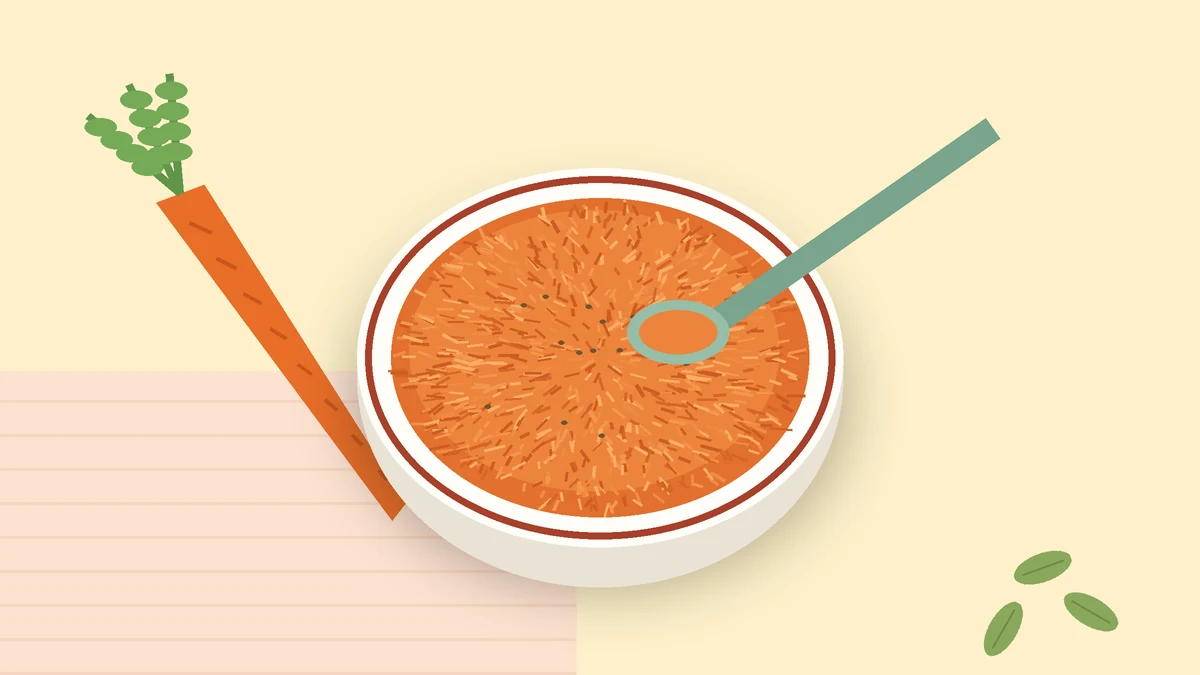
Yes, babies can have gajar halwa if you make it without sugar. A soft, no-sugar carrot halwa can be offered from around 6–8 months, once your baby has already tried carrots and dairy on their own (AAP). Cow’s milk is fine in cooking from around 6 months. It just shouldn’t be your baby’s main drink before 12 months (NHS).
Making it baby-friendly comes down to three things. Leave out the sugar, jaggery (gur) and condensed milk. Use nuts only finely ground, never whole or chopped. Blend or mash it to suit your baby’s age. Slow-cooked carrots and milk are naturally sweet, so it still tastes like the winter halwa the rest of the family loves. It takes about 10 minutes to prep and 35–40 minutes on a low flame, and makes about 1 cup, or 4–5 baby portions.
Ages: around 6–8 months+ · Textures for babies, older babies and toddlers below
Baby-safe gajar halwa checklist
- No sugar, jaggery, honey or condensed milk. Children under 2 shouldn’t have added sugars, and honey is unsafe before 12 months (CDC).
- Nuts finely ground only, and only once your baby has had nuts before. Whole nuts aren’t safe for children under 5 (NHS).
- No raisins for babies and young toddlers. Dried fruit like raisins is a choking hazard (CDC).
- Try carrots and dairy separately first. Cow’s milk and nuts are both foods that can trigger allergies, so introduce them one at a time (NHS).
- Fridge for up to 2 days, or freeze in portions (University of Illinois Extension).
Can babies have gajar halwa?
Yes, once a few basics are in place. Your baby should have started solids, around 6 months (AAP). They should already have had plain carrot and some dairy, such as yogurt or milk cooked into porridge, without a reaction. The AAP suggests introducing one new single-ingredient food every 3–5 days, which makes any reaction easier to spot.
Once those are familiar, a smooth no-sugar gajar halwa makes a nice change from plain carrot puree. Think of it as one food among many in your baby’s week, not an everyday staple.
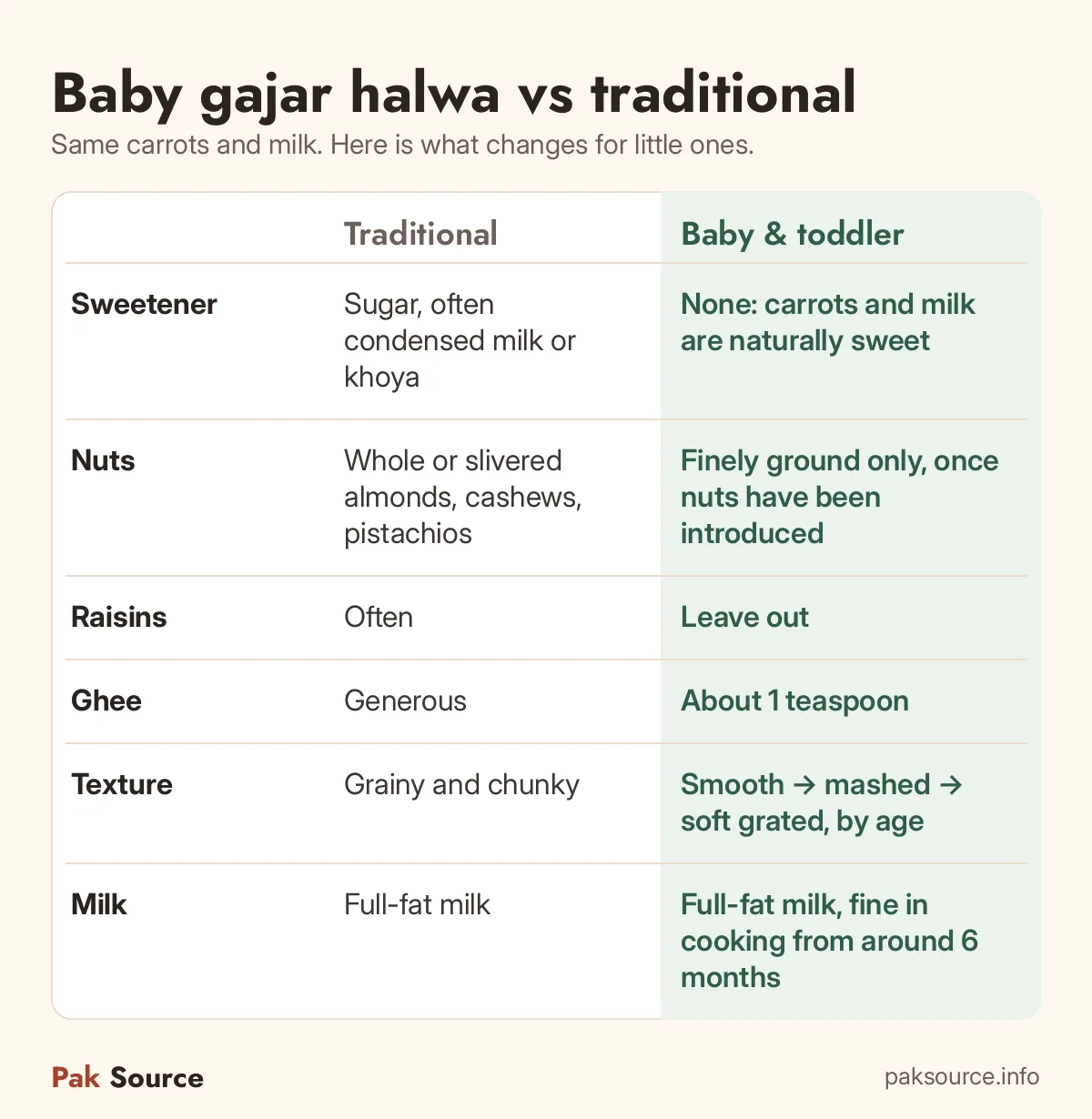
Baby gajar halwa vs traditional gajar halwa
| Traditional gajar halwa | Baby and toddler version | |
|---|---|---|
| Sweetener | Sugar, often condensed milk or khoya | None: carrots and milk are naturally sweet |
| Nuts | Whole or slivered almonds, cashews, pistachios | Finely ground only, once nuts have been introduced |
| Raisins | Often | Leave out |
| Ghee | Generous | About 1 teaspoon |
| Texture | Grainy and chunky | Smooth → mashed → soft grated, by age |
| Milk | Full-fat milk | Full-fat milk, fine in cooking from around 6 months |
One pot for the whole family: cook a bigger batch as below and spoon out your baby’s portion before you add sugar, khoya and nuts for everyone else.
No-sugar gajar halwa for babies: the recipe
Age: around 6–8 months+ · Prep: 10 min · Cook: 35–40 min · Makes: about 1 cup (4–5 baby portions) · Cuisine: Pakistani · Allergens: milk (and tree nuts if you add them)
Ingredients
- 250 g (about 2 medium) carrots, red winter desi carrots or regular orange carrots
- 1 cup (240 ml) full-fat cow’s milk
- 1 teaspoon ghee
- A small pinch of ground green cardamom
- Optional, once nuts have been introduced: 1–2 teaspoons almonds or pistachios, ground to a fine powder
Stovetop method
- Grate finely. Wash, peel and trim the carrots, then grate them on the fine side of a box grater. Finer shreds cook softer and blend more smoothly.
- Soften in ghee. Warm the ghee in a heavy-based pan over medium-low heat. Add the carrots and stir for 2–3 minutes, until they darken slightly and smell sweet.
- Add the milk. Pour in the milk and bring it to a gentle simmer.
- Cook low and slow. Simmer uncovered for 30–35 minutes, stirring every few minutes and scraping the bottom so the milk doesn’t catch. It’s ready when the milk has almost all been absorbed and the carrots are very soft.
- Finish. Stir in the cardamom, and the ground nuts if using. Let it cool to warm before serving.
Pressure-cooker shortcut
Cook the grated carrots with ¼ cup (60 ml) water for 1 whistle, about 5 minutes on medium heat, and let the pressure release naturally. Then add the ghee and milk and simmer uncovered for 15–20 minutes, stirring, until thick. Adding the milk after pressure-cooking avoids scorched or foaming milk under pressure.
How to serve gajar halwa by age
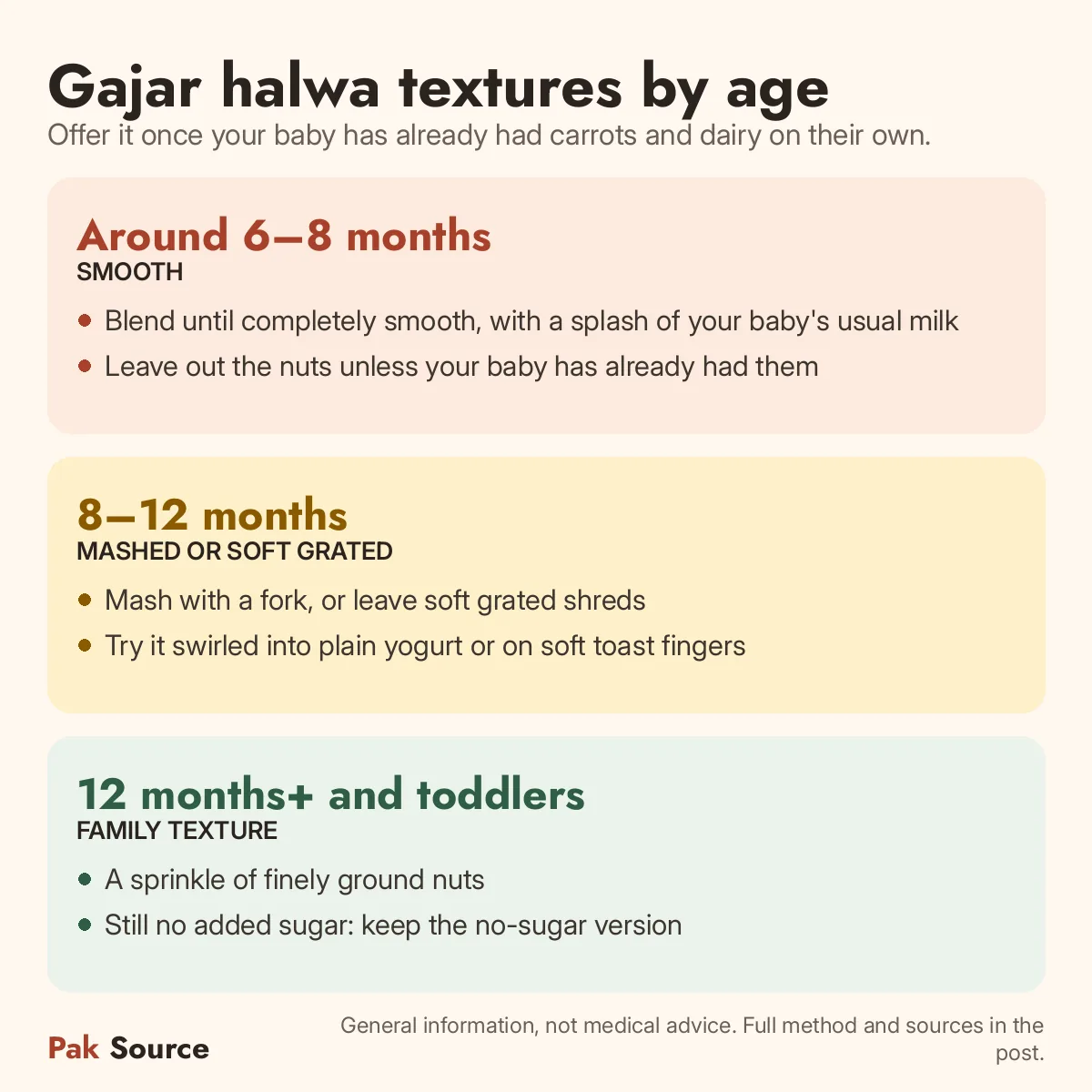
Around 6–8 months: smooth
Blend the halwa until completely smooth, adding a splash of your baby’s usual milk if it’s thick. Offer it from a spoon, or preload a spoon and let your baby hold it. Leave out the nuts unless your baby has already had them.
8–12 months: mashed or soft grated
Mash with a fork, or leave it as soft grated shreds once your baby is managing lumpier textures. The NHS encourages moving on from purees to mashed and lumpy foods as soon as babies can manage them (NHS). Try it swirled into plain yogurt, or spread thinly on soft toast fingers.
12 months+ and toddlers
Serve the family texture with a sprinkle of finely ground nuts, as a small dessert or snack. Toddlers still don’t need added sugar (CDC), so keep serving the no-sugar version. For more toddler meals, see our meal ideas for 2-year-olds.
Make ahead, store and freeze
- Cool quickly and refrigerate in a covered container within 1–2 hours (NHS).
- Fridge: up to 2 days (University of Illinois Extension; NHS).
- Freezer: freeze in small lidded trays or ice-cube trays. It’s best within 1 month (University of Illinois Extension).
- Thaw in the fridge overnight and use within 24 hours. Reheat once until steaming hot, stir well, let it cool, and test the temperature with a clean spoon before serving (NHS).
- Throw away anything left in your baby’s bowl.
Variations
- Carrot and apple halwa: grate half an apple in with the carrots for extra natural sweetness. Cook as above.
- Dairy-free carrot mash: cook the grated carrots in water with a little neutral oil instead of ghee, then mash with cardamom. Ghee is made from butter, so it isn’t dairy-free. This is really a spiced carrot mash rather than true halwa. If your baby has a cow’s milk allergy, ask your doctor which milk alternatives are suitable.
- Suji-gajar halwa: toast a tablespoon of fine semolina (suji) in the ghee before adding the carrots for a thicker, more filling version.
Gajar halwa for baby: FAQs
Can I give gajar halwa to my 8-month-old?
Yes, as long as it has no sugar, your baby has already had carrots and dairy, and the texture suits them: smooth or mashed at 8 months. Leave out nuts unless your baby has had them before, and then use them finely ground only.
Is gajar halwa good for babies?
Made without sugar, it’s mostly carrots and milk. Carrots contain beta-carotene, which the body converts into vitamin A (NIH Office of Dietary Supplements). Full-fat milk and a little ghee add fat, which young children need plenty of (AAP). It’s a tasty way to vary vegetables, as part of a mixed diet.
Can I add sugar, jaggery or honey for my 1-year-old?
It’s best not to. The CDC advises no added sugars for children under 2, and jaggery (gur) is a form of sugar. Honey must never be given before 12 months because of the risk of infant botulism (CDC). The NHS also says babies don’t need sugar or sweeteners (NHS).
Can I use condensed milk or khoya?
Skip sweetened condensed milk, which is full of added sugar. Khoya (dried milk solids) isn’t needed. Simmering the carrots in full-fat milk until it’s absorbed gives a creamy result on its own.
Can I use baby carrots or orange carrots?
Yes. Red winter desi carrots give the classic deep color and sweetness, but regular orange carrots and bagged baby carrots both work. Grate them finely.
Can babies eat ghee?
A small amount of ghee in cooking, like the teaspoon in this recipe, is fine for most babies who have already had dairy. Ghee comes from butter, so leave it out if your baby has a cow’s milk allergy unless your doctor says otherwise.
How long does gajar halwa last?
For babies, up to 2 days in the fridge, or freeze it in portions and use within about a month for best quality (University of Illinois Extension).
More desi baby food
- Salt-free chicken yakhni for babies
- Easy homemade baby food recipes, including carrot and pea puree and red lentil dal
- What to feed a 1-year-old
This article is for general information only and isn’t medical advice. Every child is different. Talk to your pediatrician (or GP or health visitor in the UK) about your child’s needs, especially if your child has a food allergy, eczema, a medical condition, or trouble with feeding or growth. If your child is choking or has signs of a severe allergic reaction (swelling of the lips or face, trouble breathing, becoming floppy or pale), call 911 in the US, 999 in the UK, or your local emergency number.
Sources
- American Academy of Pediatrics, HealthyChildren.org. When Can Babies Start Solid Foods? Updated 23 Jun 2026.
- AAP, HealthyChildren.org. Feeding & Nutrition Tips: Your 1-Year-Old. Updated 29 Oct 2020.
- NHS. Drinks and cups for babies and young children. Accessed 2 Nov 2026.
- NHS. Foods to avoid giving babies and young children. Reviewed 18 Feb 2026.
- NHS. Food allergies in babies and young children. Reviewed 22 Oct 2024.
- NHS. Your baby’s first solid foods. Reviewed 19 Feb 2026.
- NHS Best Start in Life. Storing and reheating food. Accessed 2 Nov 2026.
- CDC. Foods and Drinks to Avoid or Limit. Page dated 14 Apr 2026.
- CDC. Choking Hazards. Page dated 11 Mar 2026.
- NIH Office of Dietary Supplements. Vitamin A and Carotenoids: Fact Sheet for Consumers. Accessed 2 Nov 2026.
- University of Illinois Extension. Feeding My Baby: Storing and Reheating. Accessed 2 Nov 2026.