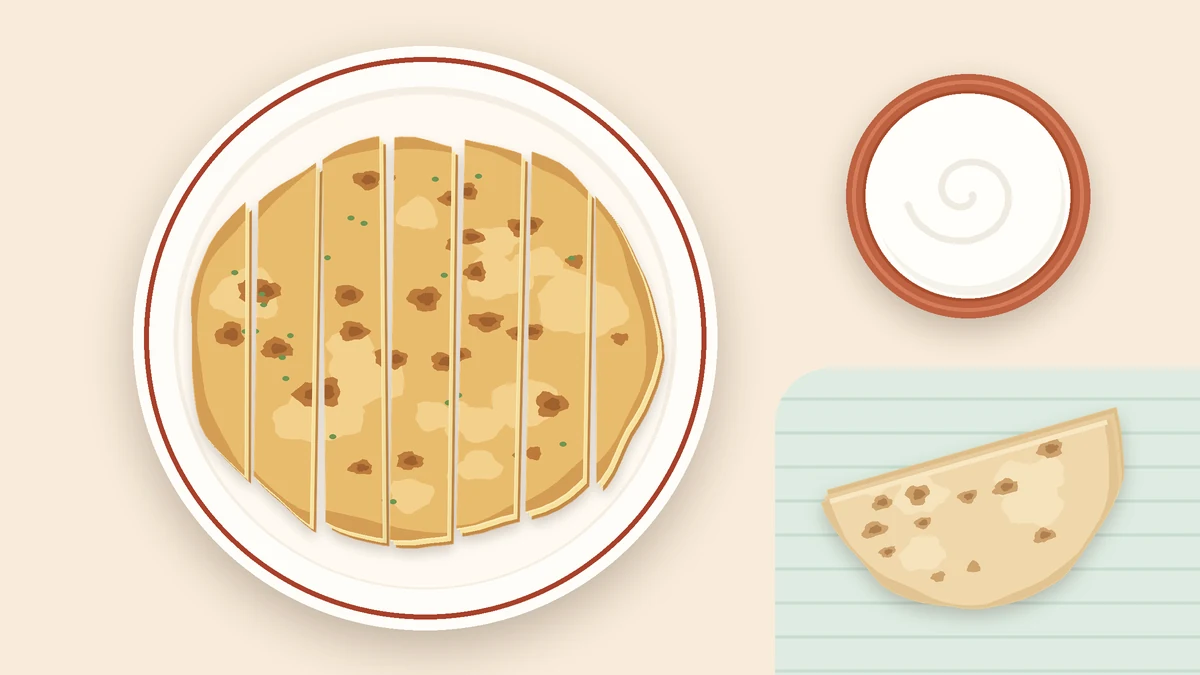
Yes, babies can eat roti, and a soft aloo paratha soon after. The NHS lists chapatti (roti) among the cooked starchy finger foods babies can have from around 6 months (NHS). An aloo paratha for baby needs a few changes from the family version. Roll it thin, cook it through but keep it soft, brush on only a little ghee or oil, and leave out the salt and chili. Then cut it into narrow strips your baby can hold (NHS).
Wheat can trigger an allergic reaction, so let your baby try plain roti before you add a filling (NHS). Jump to the soft aloo paratha recipe, or read on for how to serve roti and paratha at each age.
Ages: plain roti from about 6 months, soft aloo paratha from about 8 to 9 months, and toddlers.
Roti and paratha safety
- Wheat first, on its own. Introduce foods that can trigger allergies one at a time (NHS).
- No salt in the dough or the filling for babies (NHS). We leave out the chili too.
- Soft, but fully cooked. No doughy patches. Flour is a raw food until it is cooked (FDA).
- Cut it into narrow strips. The NHS says chapatis and other breads should be cut into narrow strips (NHS).
- No seeds on top. Skip sesame, ajwain and kalonji. Breads with seeds are on the CDC choking list (CDC), and sesame can trigger allergies (NHS).
- Cool it and stay close. Potato filling holds heat, so test it. Seat your baby upright and stay with them while they eat (NHS).
When can babies eat roti and paratha?
Roti (also called chapati, or chapatti in the UK) is on the NHS list of first finger foods from around 6 months (NHS). Offer it once your baby shows the signs of being ready for solids: sitting up with support, controlling their head and neck, and bringing objects to their mouth (CDC).
There is no official starting age for paratha. A stuffed paratha is thicker and takes more chewing than plain roti, so we suggest waiting until your baby handles roti strips and other soft finger foods well, often at around 8 to 9 months. That is a practical guide about texture, not a rule.
Allergic reactions usually start within minutes, but can take up to 2 hours (NHS). If your baby has a food allergy or eczema, or allergies run in your family, talk to your pediatrician (GP or health visitor in the UK) before you introduce wheat. Call 911 (US) or 999 (UK) if your baby’s lips, mouth or tongue swell, they struggle to breathe, or they go limp or floppy (NHS).
How to give roti and paratha to your baby by age
| Age | What to offer | Size and shape |
|---|---|---|
| About 6 to 8 months | Soft, plain roti, warm and not crisp | Narrow strips about the size of your finger |
| About 9 to 12 months | Soft roti, or a thin aloo paratha | Narrow strips, or small torn pieces once your baby picks food up between finger and thumb |
| 12 months+ | Family roti and paratha, with less ghee and little or no salt | Strips or small pieces, with dal, plain yogurt or vegetables |
Why strips? The NHS describes a finger food as a piece big enough for your baby to hold in their fist with a bit sticking out, about the size of your own finger (NHS). US advice differs a little. The AAP says to cut food for infants and young children into pieces no larger than 1/2 inch (AAP). Both agree that the food must be soft.
Roti for baby led weaning works the same way. The NHS says there is no more risk of choking when a baby feeds themselves than when they are fed with a spoon (NHS).
Tips for a soft roti
- Serve it fresh and warm, and trim off any dry or crisp edges.
- Keep it thin and cooked through. The NHS notes that white bread can form a doughy ball in the throat if it is not chewed properly (NHS), which is a good reason to avoid thick, doughy roti too.
- Offer one or two strips at a time, so your baby does not overfill their mouth.
- For a baby who prefers a spoon, tear the roti small, soak it in warm dal or salt-free chicken yakhni until soft, then mash it.
- Serve strips next to something soft, such as moong dal khichdi.
Soft aloo paratha recipe for babies and toddlers
Age: about 8 to 9 months+
Prep: 25 min
Cook: 35 min
Makes: 4 small parathas, about 6 inches (15 cm) each
Allergens: wheat, plus milk if you use ghee
Ingredients
- 1 cup (120 g) whole-wheat flour (atta), plus extra for dusting
- About 1/3 cup (80 ml) warm water
- 1 teaspoon oil or melted ghee, for the dough
- 1 medium potato, about 5 oz (150 g)
- 2 tablespoons peas, fresh or frozen, or finely grated carrot
- 1/4 teaspoon ground cumin
- A pinch of turmeric
- About 1 teaspoon ghee or oil, for brushing
Method
- Boil the potato whole in unsalted water for 20 to 25 minutes, until a knife slides in easily. Add the peas or carrot for the last 5 minutes, then drain.
- Meanwhile, mix the flour and oil. Add the water a little at a time until you have a soft dough. Knead for 3 to 4 minutes, cover and rest for 15 minutes.
- Peel the potato and mash it with the peas until smooth, with no whole peas. Mix in the cumin and turmeric and let it cool.
- Divide the dough and the filling into 4 portions each. Roll one dough ball into a 4 inch (10 cm) circle, put a portion of filling in the center, gather the edges over it and pinch to seal.
- Flatten the parcel, dust it with flour and roll it gently into a thin 6 inch (15 cm) round.
- Heat a tawa or heavy frying pan (skillet) over medium heat. Cook the paratha for about 1 minute on each side, until pale spots appear. Brush each side lightly with ghee and cook for 1 to 2 minutes more, pressing down the edges, until both sides have light golden spots and no doughy patches are left.
- Stack the cooked parathas in a clean cloth or covered dish, so the steam keeps them soft. Cool until just warm, then cut.
Flours vary, so treat the water amount as a starting point. Peas can also trigger allergies (NHS), so use a vegetable your baby has already tried.
How to cut it by age
- About 8 to 9 months: narrow strips the size of your finger. An aloo paratha for a 9 month old baby should be thin, soft and easy to grip.
- 10 to 12 months: narrow strips or small torn pieces.
- 12 months+: a paratha for a toddler can be strips, small wedges or a roll-up, with plain yogurt or dal for dipping.
More paratha for baby ideas
- Palak paratha for baby: knead 2 tablespoons of smooth, cooked spinach puree into the dough and use less water.
- Pumpkin (kaddu) or sweet potato: mash soft-cooked pumpkin into the dough, or swap sweet potato for the potato.
- Paneer: crumble pasteurized paneer finely into the potato. Babies can have pasteurized full-fat cheese from 6 months (NHS). Paneer adds milk as an allergen.
- Keema: for babies who already eat meat, add a thin layer of finely crumbled, fully cooked ground meat. Ground meat should reach 160°F (71°C), and ground chicken 165°F (74°C) (FDA).
Make-ahead, freezing and lunch boxes
- Fridge: cool cooked parathas within 1 to 2 hours and keep them covered for up to 2 days (NHS). Keep keema parathas for 1 day only (University of Illinois Extension).
- Freezer: stack cooled, fully cooked parathas with baking paper (parchment) between them and seal in a labeled freezer bag. They are best within 1 month (University of Illinois Extension).
- Defrost in the fridge, never at room temperature, and use within 24 hours (NHS).
- Reheat once only, in a covered pan with a few drops of water, until steaming hot all the way through. Then cool and test (NHS).
- Lunch boxes: pack paratha strips cold in a cool bag with ice packs (NHS). Perishable food should not sit out for more than 2 hours, or 1 hour above 90°F (32°C) (FDA). See our Pakistani lunch box ideas for toddlers.
Aloo paratha for baby: FAQs
Can my 6-month-old eat roti?
Yes, if your baby has started solids. Offer a soft, plain, warm roti cut into narrow strips, and introduce wheat on its own so you can spot any reaction. Keep stuffed paratha for a little later. For more first foods, see our easy homemade baby food recipes.
Is paratha too oily for babies?
Not if you go easy on the ghee. The NHS says young children, especially those under 2, need the energy that fat provides (NHS). About 1/4 teaspoon of ghee or oil brushed over each paratha is enough to keep it soft. Skip deep-fried and very flaky, crisp parathas for babies.
Atta or maida for baby roti?
Whole-wheat atta is the traditional choice and works well. The NHS says wholegrain foods are fine, but under-2s should not have only wholegrain starchy foods, because the fiber can fill them up before they get the energy and nutrients they need (NHS). So offer other starchy foods too, such as rice and potato.
My baby gags on roti. What should I do?
Gagging is a normal reflex while babies learn to chew and swallow. It is loud, and your baby’s eyes may water. Choking is quiet (NHS). Offer thin, soft, narrow strips and stay with your baby. Learn what to do if a child is choking, and consider a baby first aid course.
Can I add salt for my toddler?
There is no need to add salt to a child’s food (NHS). If the family dough is salted, keep it light. Children aged 1 to 3 should have no more than 2 g of salt a day in total, and babies under 1 less than 1 g (NHS).
This article is for general information only and isn’t medical advice. Every child is different. Talk to your pediatrician (or GP or health visitor in the UK) about your child’s needs, especially if your child has a food allergy, eczema, a medical condition, or trouble with feeding or growth. If your child is choking or has signs of a severe allergic reaction (swelling of the lips or face, trouble breathing, becoming floppy or pale), call 911 in the US, 999 in the UK, or your local emergency number.
Sources
- NHS. Your baby’s first solid foods. Reviewed 19 Feb 2026.
- NHS Best Start in Life. Preparing food safely. Accessed 12 Nov 2026.
- NHS Best Start in Life. Choking and gagging on food. Accessed 12 Nov 2026.
- NHS Best Start in Life. Storing and reheating food. Accessed 12 Nov 2026.
- NHS. Food allergies in babies and young children. Reviewed 22 Oct 2024.
- NHS. Food allergy. Reviewed 20 Aug 2026.
- NHS. Foods to avoid giving babies and young children. Reviewed 18 Feb 2026.
- NHS. What to feed young children. Reviewed 28 Mar 2023.
- NHS. Salt in your diet. Reviewed 17 Apr 2023.
- NHS. How to stop a child from choking. Reviewed 28 Oct 2024.
- Centers for Disease Control and Prevention (CDC). When, What, and How to Introduce Solid Foods. Page dated 14 Apr 2026.
- CDC. Choking Hazards. Page dated 11 Mar 2026.
- American Academy of Pediatrics, HealthyChildren.org. Choking Prevention. Updated 27 Feb 2026.
- U.S. Food and Drug Administration (FDA). Handling Flour Safely: What You Need to Know. Content current as of 5 Mar 2024.
- FDA. Safe Food Handling. Content current as of 5 Mar 2024.
- University of Illinois Extension. Feeding My Baby: Storing and Reheating. Accessed 12 Nov 2026.