Yes, babies can have suji from around 6 months, once they’ve started solids, as a smooth, lump-free porridge (AAP). Suji (also called sooji, rava or semolina) is made from wheat, and wheat is one of the foods that can trigger allergic reactions, so offer it on its own first and watch for a reaction (NHS).
You don’t need sugar. Children under 2 shouldn’t have added sugars (CDC), and ripe banana or apple puree sweetens suji well on its own. Cow’s milk is fine in cooking from around 6 months, just not as a main drink before 12 months (NHS). Water works too. These three recipes follow your baby’s age, and there’s a chilla for toddlers as well:
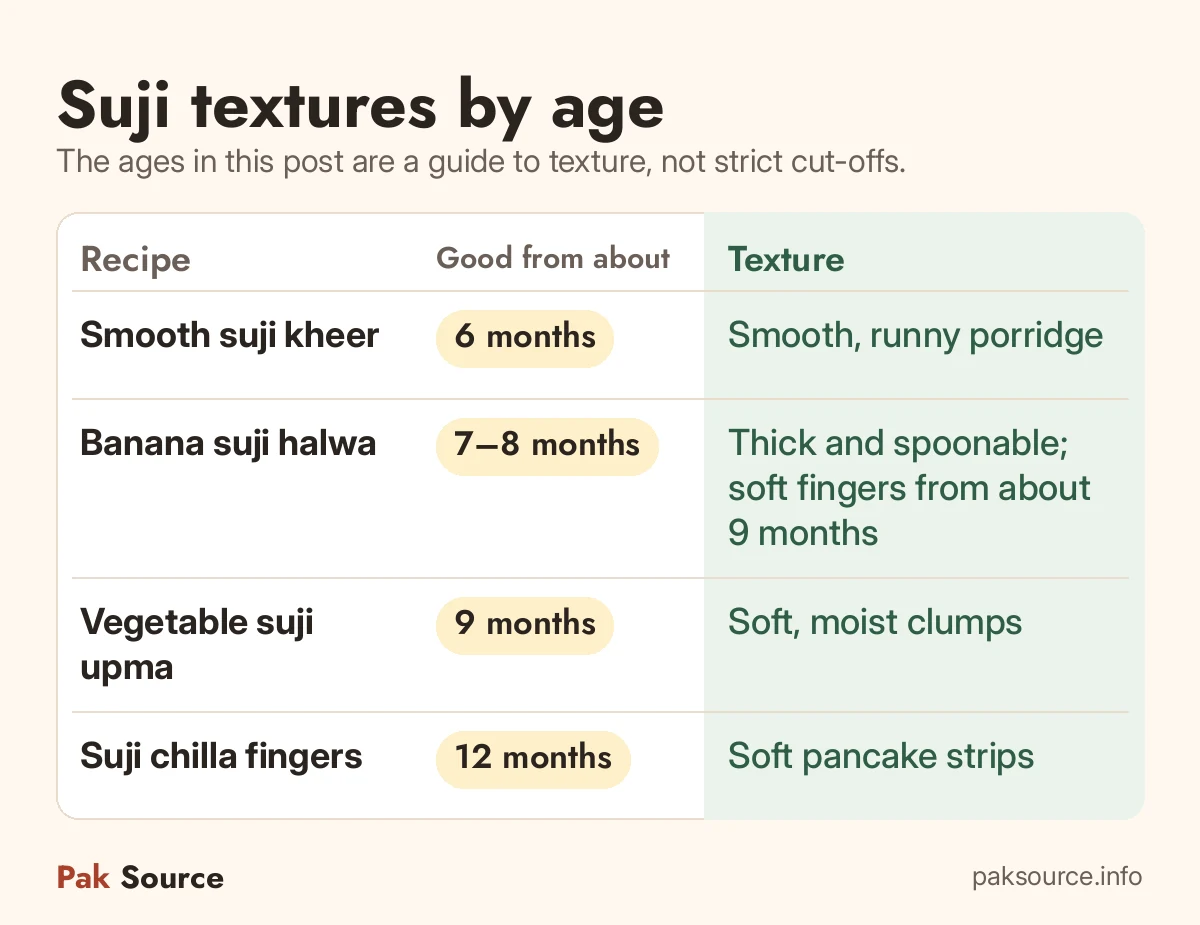
| Recipe | Good from about | Texture |
|---|---|---|
| Smooth suji kheer | 6 months | Smooth, runny porridge |
| Banana suji halwa | 7–8 months | Thick and spoonable; soft fingers from about 9 months |
| Vegetable suji upma | 9 months | Soft, moist clumps |
| Suji chilla fingers | 12 months | Soft pancake strips |
Ages: about 6 months to toddler · Textures for each stage in every recipe
Baby suji checklist
- Wheat first, on its own. Introduce suji by itself, one new food at a time (NHS).
- No sugar, jaggery (gur) or honey. No added sugars under 2, and no honey before 12 months (CDC). Fruit is fine (NHS).
- No salt or stock cubes in your baby’s food or cooking water (NHS), and no chili.
- Use pasteurized milk. If all you can get is loose, unpasteurized milk, bring it to a boil first (WHO).
- Lump-free for young babies. Whisk well, then blend or sieve if you need to.
- No whole nuts or raisins. Whole nuts aren’t safe for children under 5, so add nuts only crushed or ground (NHS). Raisins are on the CDC’s choking-hazard list (CDC).
- Cool and test hot food before serving, and always stay with your baby while they eat (NHS).
Can babies have suji?
Yes. Most babies are ready for solids around 6 months, once they can sit with support, hold their head steady, open their mouth for food and swallow rather than push it back out (AAP). Suji suits this stage because it cooks down to a soft, smooth porridge.
The ages in this post are a guide to texture, not strict cut-offs. The NHS advises moving babies from purees to mashed, lumpy and finger foods as soon as they can manage them (NHS), so go by what your own baby handles.
How to introduce suji safely
- Start plain. For the first taste, cook a little suji in water only, with no ghee, milk or fruit unless your baby has already had them. Then a reaction is easier to pin down. The AAP suggests one new single-ingredient food every 3–5 days (AAP).
- Watch your baby. Reactions usually start within a few minutes, but they can take up to 2 hours (NHS). For a mild reaction, such as a rash, stop the food and call your pediatrician (GP or health visitor in the UK).
- Know when to get help. Call 911 (US), 999 (UK) or your local emergency number if your baby’s lips, mouth or tongue swell, they struggle to breathe, or they go limp or floppy (NHS).
- Ask first if your baby is at higher risk. If your baby already has a food allergy or eczema, or there’s a family history of allergy, eczema, asthma or hay fever, speak to your doctor or health visitor before you start (NHS).
- Keep it going. Once your baby tolerates wheat, make it a regular part of their diet (NHS).
Suji and iron
Suji is a useful grain, but it isn’t one of the iron-rich foods the AAP and CDC name for babies, such as meat, poultry, eggs, beans, lentils and iron-fortified cereal (AAP; CDC). So serve those foods at other meals, and keep breast milk or formula as the main drink in the first year (NHS).
Recipe 1: Smooth suji kheer (about 6 months+)
Age: about 6 months+ · Prep: 2 min · Cook: 10 min · Makes: about ¾ cup (3–4 baby portions) · Cuisine: Pakistani / Indian · Allergens: wheat; milk (in ghee and cow’s milk)
Suji kheer ingredients
- 2 tablespoons (20 g) fine suji
- ½ teaspoon ghee
- 1 cup (240 ml) warm water or full-fat pasteurized cow’s milk
- Optional: 1–2 tablespoons apple puree or mashed ripe banana
- Optional: a small pinch of ground green cardamom
Look for plain fine suji (barik suji). Instant upma and halwa mixes can contain salt and sugar, so check the label.
How to make suji kheer
- Melt the ghee in a small, heavy-based pan over low heat. Add the suji and stir for 2–3 minutes, until it smells nutty but is still pale.
- Take the pan off the heat. Add a splash of the warm liquid and whisk (it may spit, so stand back). Keep adding it a little at a time, whisking, until it’s all in.
- Return the pan to low heat. Whisk for 5–7 minutes, until creamy and the grains taste soft, not raw.
- Take it off the heat and stir in the fruit and cardamom, if using. Let it cool to warm. It thickens as it cools.
Suji kheer texture by age
- About 6 months: blend it or push it through a sieve until there are no lumps. Thin it with warm breast milk, formula or water until it runs off the spoon.
- 7–9 months: serve it thicker, with mashed fruit stirred through for soft lumps.
- 9–12 months+: serve it thick from a preloaded spoon so your baby can try feeding themselves. Once nuts have been introduced, you can stir in 1 teaspoon of finely ground almonds or pistachios.
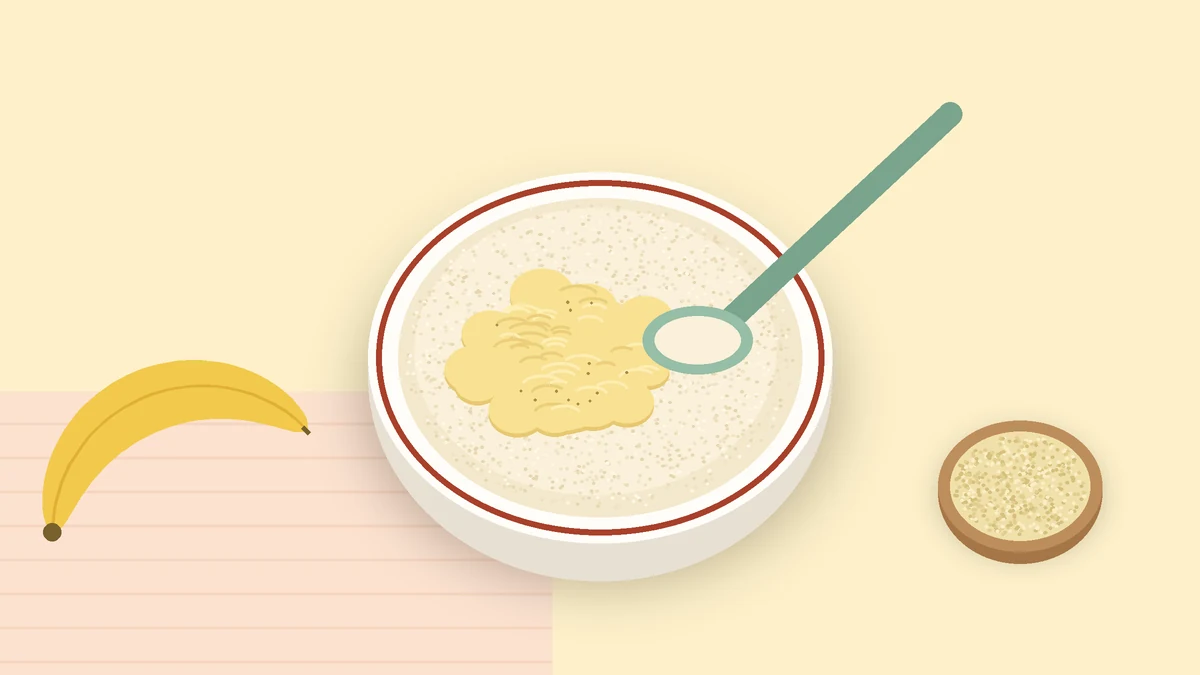
Recipe 2: Banana suji halwa (about 7–8 months+)
Age: about 7–8 months+ · Prep: 2 min · Cook: 10 min · Makes: about ½ cup (2–3 baby portions) · Allergens: wheat; milk (in ghee and cow’s milk)
This is the traditional roasted-suji method with the sugar left out. Mashed ripe banana does the sweetening. For another no-sugar sweet, try our gajar halwa for babies.
Banana suji halwa ingredients
- 2 tablespoons (20 g) fine suji
- 1 teaspoon ghee
- ½ cup (120 ml) warm water or full-fat pasteurized cow’s milk
- ½ very ripe banana (about 50 g), mashed
- A small pinch of ground green cardamom
How to make banana suji halwa
- Melt the ghee in a small, heavy-based pan over low heat. Add the suji and stir for 3–4 minutes, until light golden and nutty.
- Take the pan off the heat and slowly whisk in the warm liquid. It may spit, so stand back.
- Return to low heat and stir for 2–3 minutes, until thick and starting to pull away from the pan.
- Stir in the mashed banana and cook for 1 more minute. Stir in the cardamom and let it cool to warm.
Banana suji halwa texture by age
- 7–8 months: thick but spoonable. Mash out any banana lumps, and loosen with a little milk or water if it’s stiff.
- About 9 months+: make soft fingers. Use only ¼ cup (60 ml) of liquid, press the halwa into a small greased dish, and let it cool for 15–20 minutes to firm up. Cut it into strips big enough to hold in a fist with a bit sticking out (NHS). They should squash easily between your fingers. If it’s too soft to cut, just serve it from a spoon.
- 12 months+: serve a small spoonful as a dessert, with finely ground nuts if your child has already had them.
Making halwa for the family too? Spoon out your baby’s portion before you add sugar, whole nuts or raisins to the rest.
Recipe 3: Vegetable suji upma (about 9 months+ and toddlers)
Age: about 9 months+ · Prep: 5 min · Cook: 15 min · Makes: about 1 cup (2–3 baby portions) · Allergens: wheat; milk if using ghee (use oil for a dairy-free version)
Vegetable upma ingredients
- ¼ cup (40 g) fine or medium suji
- 1 teaspoon ghee or neutral oil
- 1 tablespoon very finely chopped onion
- 2 tablespoons finely grated carrot
- 1 tablespoon peas, fresh or frozen
- A pinch of ground cumin
- 1 cup (240 ml) hot water, plus 2 tablespoons for the vegetables
How to make vegetable upma
- Dry-roast the suji in a pan over low heat for 3–4 minutes, stirring, until it smells nutty. Tip it onto a plate.
- Warm the ghee in the same pan over low heat. Cook the onion for 3–4 minutes, until soft and see-through, without browning.
- Add the carrot, peas and 2 tablespoons of water. Cover and cook for 5 minutes, until very soft, then squash the peas with the back of a spoon. Stir in the cumin.
- Pour in the 1 cup of hot water and bring it to a simmer. Lower the heat and pour in the roasted suji in a thin stream, stirring all the time.
- Cover and cook on the lowest heat for 3–4 minutes, then rest for 2 minutes with the lid on. It should be soft and moist. Add a splash of hot water if it looks dry.
Vegetable upma texture by age
- About 9 months: mash lightly and serve from a spoon. Make sure each vegetable piece squashes easily.
- 10–12 months: serve as soft, moist clumps your baby can pick up.
- 12 months+ and toddlers: serve the family version, with a very small pinch of salt at most. Children aged 1–3 should have no more than 2 g of salt a day in total (NHS).
What to leave out of your baby’s upma: whole mustard seeds, curry leaves, peanuts, cashews, the hard chana or urad dal in a traditional tempering, and green chili. Whole or chopped nuts and seeds are on the CDC’s choking-hazard list (CDC), and leaves and hard dal pieces are tricky for babies to manage. Mustard can also trigger allergies (NHS). Ground spices give you the flavor without the bits.
Want to add chicken? Replace the water with our salt-free chicken yakhni and stir in finely shredded cooked chicken. Meat is one of the iron- and zinc-rich foods the AAP recommends for babies (AAP). With chicken in it, keep it in the fridge for 1 day only (University of Illinois Extension).
Suji chilla fingers for toddlers (12 months+)
Age: 12 months+ · Prep: 5 min + 10 min resting · Cook: 8 min · Makes: 2 small chillas · Allergens: wheat, milk
Suji chilla ingredients
- ¼ cup (40 g) fine suji
- 2 tablespoons plain full-fat pasteurized yogurt
- About 3 tablespoons water
- 2 tablespoons finely grated carrot or zucchini
- A pinch of ground cumin
- ½ teaspoon oil or ghee for the pan
How to make suji chilla
- Mix the suji, yogurt and water and rest for 10 minutes so the suji softens. Add a little more water if needed, until it pours like pancake batter.
- Stir in the grated vegetable and cumin.
- Lightly oil a non-stick pan over medium-low heat. Pour in half the batter and spread it into a thin round. Cover and cook for 2–3 minutes.
- Flip and cook for 2 more minutes, until golden and there’s no wet batter left. Repeat with the rest.
- Cool slightly and cut into fingers.
Packing them for nursery or daycare? They contain dairy, so pack them cold in an insulated bag with two ice packs (USDA). For more ideas that travel well, see our Pakistani lunch box ideas for toddlers.
How to stop suji going lumpy
To keep suji smooth, roast it first, take the pan off the heat, add warm liquid slowly while whisking, then cook it on low heat and keep whisking until thick.
- Use fine suji. It softens faster and gives a smoother porridge than coarse suji.
- Roast it first. Stir it in the ghee or a dry pan until it smells nutty, which helps keep the grains separate.
- Add the liquid slowly. Whisk each splash in before you add the next. For upma, do the reverse: pour the suji in a thin stream into simmering water, stirring all the time.
- Stay at the pan. Keep the heat low and keep whisking. Suji thickens quickly, and it thickens more as it cools, so stop when it’s a little looser than you want.
- Fix any lumps. Whisk hard with a splash of liquid. For a young baby, let it cool a little, then blend it or push it through a sieve.
How to store, freeze and reheat suji
- Cool quickly and refrigerate within 1–2 hours of cooking (NHS).
- Fridge: up to 2 days in a covered container (University of Illinois Extension; NHS).
- Freezer: freeze small portions in lidded trays, then label and date them. They’re best within 1 month (University of Illinois Extension).
- Defrost in the fridge or on the microwave’s defrost setting, never at room temperature, and use within 24 hours (NHS).
- Reheat once only, until steaming hot all the way through. Suji sets firm when cold, so stir in a splash of water or milk. Let it cool, then test it with a clean spoon before feeding (NHS; University of Illinois Extension).
- Throw away anything left in your baby’s bowl.
Suji for baby: FAQs
Can I give suji to my 6-month-old?
Yes, once your baby has started solids. Offer a small amount of smooth, runny suji cooked in water, with no sugar or salt, and introduce it on its own so you can spot any reaction to wheat.
Suji kheer or suji halwa: which is better for babies?
Neither is healthier. The difference is texture. Thin kheer suits babies just starting solids, and thicker halwa suits babies who are managing more texture. Choose the one that matches what your baby can handle now.
Is suji good for baby weight gain?
No single food makes a baby gain weight, and suji can’t promise that. Cooked with milk and a little ghee, it does provide energy, but it works best as one part of a varied diet, and adding sugar isn’t the answer. Babies gain weight at different rates, and it’s normal for gain to slow as they get older or while they’re ill (NHS). If you’re worried about your baby’s weight, talk to your pediatrician, GP or health visitor.
Is suji good for constipation?
We didn’t find suji named as a remedy in the health guidance we use. The NHS advises plenty to drink and a varied diet with lots of fruit and vegetables, and says to see a GP if you think your child may be constipated (NHS).
Can I use sugar, jaggery or honey?
It’s best not to. The CDC says children under 2 shouldn’t have added sugars, and honey must not be given before 12 months because of the risk of botulism (CDC). Jaggery (gur) is a form of sugar. The NHS goes further and advises avoiding food and drink with sugar or sweeteners for children aged 4 or younger, while noting that eating fruit is fine (NHS).
Can babies with a wheat allergy or celiac disease have suji?
No. Suji is made from wheat (Allergy UK), and wheat contains gluten (NHS). If your baby has a diagnosed wheat allergy or celiac disease (coeliac disease in the UK), follow your doctor’s or dietitian’s advice on what to use instead. If you only suspect a problem, speak to them before cutting out a major food, because that can leave gaps in your baby’s diet (NHS).
Can I give my baby suji every day?
It’s better to rotate. Eating a variety of foods is good for nutrition and food safety (FDA), and the AAP advises switching up grains (AAP). Alternate suji with moong dal khichdi, oats and the other first foods in our easy homemade baby food recipes.
More desi baby food
- Khichdi for babies: moong dal khichdi by age
- No-sugar gajar halwa for babies and toddlers
- Salt-free chicken yakhni for babies
- Easy homemade baby food recipes
This article is for general information only and isn’t medical advice. Every child is different. Talk to your pediatrician (or GP or health visitor in the UK) about your child’s needs, especially if your child has a food allergy, eczema, a medical condition, or trouble with feeding or growth. If your child is choking or has signs of a severe allergic reaction (swelling of the lips or face, trouble breathing, becoming floppy or pale), call 911 in the US, 999 in the UK, or your local emergency number.
Sources
- American Academy of Pediatrics, HealthyChildren.org. When Can Babies Start Solid Foods? Updated 23 Jun 2026.
- AAP, HealthyChildren.org. Heavy Metals in Baby Food: Reducing Risk of Exposure. Updated 26 Sep 2025.
- CDC. Foods and Drinks to Avoid or Limit. Page dated 14 Apr 2026.
- CDC. Choking Hazards. Page dated 11 Mar 2026.
- CDC. Iron. Page dated 14 Apr 2026.
- NHS. Your baby’s first solid foods. Reviewed 19 Feb 2026.
- NHS. Foods to avoid giving babies and young children. Reviewed 18 Feb 2026.
- NHS. Food allergies in babies and young children. Reviewed 22 Oct 2024.
- NHS. Food allergy. Reviewed 20 Aug 2026.
- NHS. Drinks and cups for babies and young children. Reviewed 5 Oct 2022.
- NHS. Salt: the facts. Reviewed 17 Apr 2023.
- NHS. Your baby’s weight and height. Reviewed 20 Sep 2023.
- NHS. Constipation in children. Reviewed 2 Aug 2023.
- NHS. Coeliac disease. Reviewed 31 Mar 2023.
- NHS Best Start in Life. Storing and reheating food. Accessed 5 Nov 2026.
- U.S. Food and Drug Administration. What You Can Do to Limit Exposure to Arsenic. Content current as of 27 Apr 2022.
- World Health Organization. Influenza: A(H5N1), questions and answers. Published 16 May 2024.
- Allergy UK. Wheat allergy. Accessed 5 Nov 2026.
- USDA Food Safety and Inspection Service. Keeping “Bag” Lunches Safe.
- University of Illinois Extension. Feeding My Baby: Storing and Reheating. Accessed 5 Nov 2026.